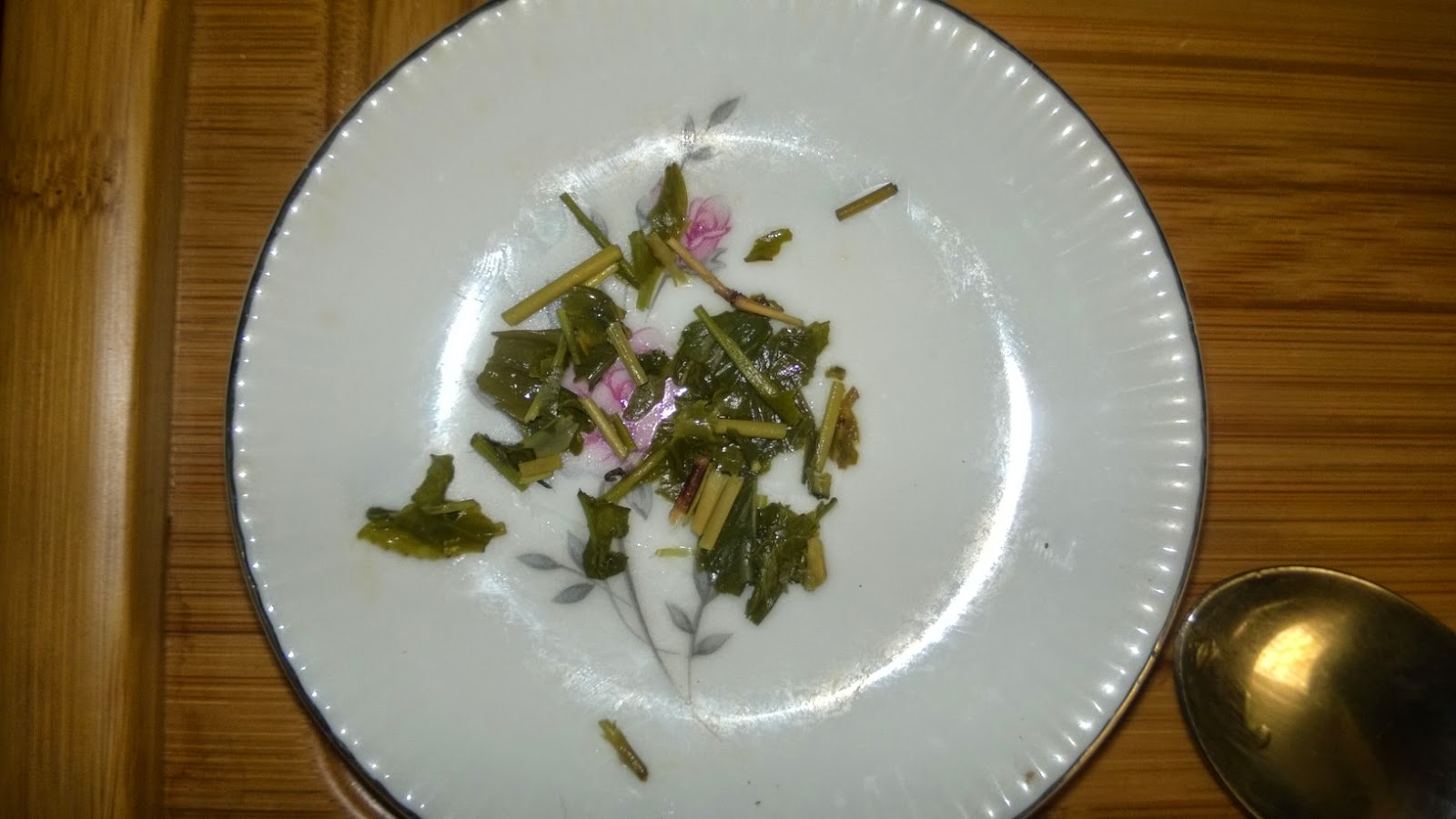
Sencha of the Earth 2013 from Obubu Teas via Tealet


I purchased the Alfredo and Akky Tea Box from Tealet fairly recently, and today I’ll be looking at the Sencha of the Earth from Obubu Tea. Before I get to the tea itself, I want to talk about the packaging a little. This was my first order from Tealet, even though I’ve known about Tealet for quite some time, I’ve never bought anything before because for the most part Tealet sells their teas by 15g, which is something of a weird increment to sell by when most tea stores sell either 25-28gs or an ounce for the smallest non-sample sized available, but I decided to buy the Alfreddo and Akky Tea Box because it was fairly inexpensive and I had an overwhelming desire to finally try some of their sourced teas. I like the idea and spirit behind Tealet, but I’d be more comfortable buying teas from them in the future if they increased the amount of tea, even if that means raising the price.


The dry leaf had a peppery vegetable smell and had the standard sencha look, mostly unbroken, but there were little bits of shredded leaf; mostly green, but with a little light yellow thrown in. Regardless I started brewing at 175 °F in my houhin for one minute. Immediately I could smell a green bean aroma while the taste was mostly nutty, but I could also distinguish both bark and something sweet, although there was some bitterness as well. I’d like the bitterness to be more pronounced, but this steeping was fine, right now it was sweeter than being bitter and has a pleasant astringency. It had a a very pleasant mouthfeel, a little thicker then what one’d expect for a Japanese tea.


For my next steeping I brewed at 180 °F for one and half minutes. This time the aroma was nutty and maybe a little seaweed. While the taste was drastically different from the last; this time it had a strong nutty taste, a mild seaweed taste and very mild honey notes. This infusion was still sweeter then bitter, but not as sweet as the last. I am starting to like this tea more. Generally I like bitterness in Japanese greens.


For my third steeping I brewed at 185 °F for two minutes. This was my favorite infusion; it had a perfect balance of sweetness and bitterness. The aroma was pretty much gone by now, but it still had a nutty taste, almost like a Long Jing, but a little more grassy this time, it still had a sweetness there, but it was a little muted. While it did not have the same mouthfeel of the first and second infusion, this was by far my favorite steeping


I got three more infusions out of the leaves, but after the third they became very light. Overall I rather enjoyed this tea. I haven’t had much luck with Japanese teas this year, but this is definitely my favorite Sencha that I tried (although I still have two more in the Tealet Tea Box, so who knows if it will still be my favorite afterwards). This Sencha of The Earth revitalized my interest in Japanese greens, and I’ll have to keep my eye on Obubu Tea.

Crimson Lotus Tea’s 2009 Xinghai Bulang Qiaomu Sheng Puerh


I tried a sample of Crimson lotus Tea’s 2009 Xinghai BulangQiaomu Sheng Puerh.  This is the first puerh I’ve looked at here although not my first puerh. I wanted to have a short gongfu session, but this tea lasted a lot longer than I thought it would (eighteen infusions in total). The sample I have was mostly in large chunks, each around five to eight grams a piece.


I began with three short rinses with boiling water for six seconds each. For my first infusion I steeped for ten seconds (subsequent steepings I added five seconds). For the most part my first three infusions were pretty similar; they had an earthy scent and it mostly had a woodsy taste, although there were hints of very dark chocolate and some bitterness. I didn’t really care for these three infusions; it was a little too dark for me although the liquor was a very light for the strength of the tea.


For my next three infusions I used boiling water for twenty –five seconds (plus five seconds for each subsequent infusions). This time it had a smokey aroma, although I could still smell wet earth. The taste became very smooth and dark chocolaty, there was a little bit of sweetness now, but it still had some bitterness. Normally I am not a fan of darker teas, but this was very pleasant, it reminded me a little of Mexican hot chocolate without cinnamon. Unfortunately at this point I burned my hand pretty bad so I stopped taking pictures, but I still continued on, for the most part it the liquor became darker as I went on, until the thirteenth infusion when it started to become lighter.


At the seventh steeping, it started to become really interesting. I used boiling water and steeped for forty-five seconds. The aroma was very similar to previous, earthy and smokey, but the taste had a new edge to it. While it still was very chocolaty and woodsy with a little sweetness , but there was new spiciness to it. I could taste a little chili, but I mostly was getting cinnamon and cocoa powder. I differentiate the dark chocolaty taste from before with the cocoa powder taste which was a little drier. There was still some bitterness, but it became very similar to Mexican hot chocolate now that I was getting the spicy notes. This was probably my favorite infusion even though it was still darker then my normal teas.

I am going to skip ahead to my thirteenth infusion, by now I was steeping for seventy seconds. By now the scent is mostly gone, although the leaves are starting to smell very burnt. As for taste it started to have a coffee taste, more like a French roast. Before the tea tasted bitter, but with a sweet aftertaste, this time I would say it was sweet with a bitter aftertaste.  I could still taste chocolate in this, but it became very mellow and the spicy notes were still present although the cinnamon and chili started to become murky. After this infusion the brewed tea became lighter.


I liked this tea, while I am normally not a darker teas so I generally avoid most puerhs, but I think I’ll have to reconsider a lot of teas I normally write off. And while I did enjoy the later infusions more so than the earlier ones, I’d definitely try this tea again if I can find it. 

What-Cha’s Discover Russia Premium Non-Black

So I’ve been drinking What-Cha’s Discover Russia Premium Non-Black sampler, and I have been surprised by how much I like some of the teas. I decided to post all my thoughts in one post rather than in multiple because I only had enough tea to formulate my first impressions.


Before I get to my impressions on the tea, I have to state that these are my first Russian teas; I’ve had Russian Caravan before, but I never had loose leaf Russian teas before.

Krasnodar Host Tea Estate Oolong Tea


The dry leaves on this particular tea can be quite wide and flattened to thin and twisted. I brewed 185°F for five minutes. The liquor was quite dark brown-orange. It had a slightly grassy aroma as well as a mild woodsy scent and a really fruity taste, although it tasted very similar to a run of the mill Russian Caravan tea, but it lacked the smoky Lapsang Souchong taste. There was a moderate tobacco taste edge to this tea that lingered.


If this tea was sold individually I probably would not buy this particular tea, I don’t particularly like teas that taste like tobacco. Although this is a nice tea that straddles the line between oolong and black, you may enjoy it.  

Krasnodar Host Tea Estate Yellow Tea


Like most of the other teas in this sampler, the dry leaves are quite dark for non-black teas, and have some lighter browns. The leaves feel a little like crispy bark. I brewed at 176°F for four minutes; this produces very dark golden-amber liquor. There was a slight aroma, although it was too minor for me to identify. There was a very sharp taste to this tea that took me a couple minutes to identify. At first I was thinking something acidic, but then I realized it has a watered down lemon juice taste, I have to note that this is not an acidic tea, but is very reminiscent of one. I also noticed a dry hay taste to this tea.


I enjoyed this tea, and would probably buy this tea if it was sold individually. This is a definitely a yellow tea, between a white and a green, although if I tasted it blind I would probably say it is a green. This is definitely an everyday type of tea that should pair well with most foods.

Krasnodar Host Tea Estate Green Tea


The dry leaves were olive green and a very dark green; the leaves were twisted although there were a couple flattened leaves and a few light stems. I brewed at 176°F for two minutes this produced a tea with a very light yellow liquor. The taste was mostly grassy, but I could taste an intense sweet peach edge to it as well.


I loved this tea. I would definitely buy it if it was sold individually, although I don’t think it is the type of tea I would drink often; it felt very much like a tea to enjoy on a hot summer day. 

Krasnodar Solohaul Tea Estate Green Tea


The leaves were dark with a little olive green mixed in, and were flat and looked like thin strips of tree bark. This time I brewed at 176°F for three minutes, it produced yellowish liquor. The major taste was nectarine although there was a grassy finish that I quite enjoyed.


 This felt like a better version of the Krasnodar Premium Dagomys Tea Estate Green Tea and I definitely would purchase it again, which may be ironic because I have the least to say about this tea. 

Krasnodar Premium Dagomys Tea Estate Green Tea


Like all the others the leaves are considerably darker then what you would expect for a green tea and the leaves are twisted, although the leaves were softer than the others in this sampler. I want to say the leaves had a crumpled look to them, the dry leaves reminded me very much of crumpled velvet. I brewed at 176°F for two and half minutes. The liquor was light yellow, there was a slight cherry aroma. The taste was very mellow, a little fruity that was hard to narrow down, but there was a lingering grassy aftertaste.


I probably would not buy this tea, like the other premium tea in this sampler it had a very light taste, too light for me. This felt more like a white then a green to me. 

Krasnodar Premium Solohaul Tea Estate Green Tea


The dry leaves were long thin strips that were light olive green and a little rusty brown mixed. This was the only tea in this sampler that was not twisted. I brewed at 176°F for three minutes. It didn’t have much of an aroma, although I wouldn’t say any of these teas had an easily identifiable aroma (I had a hard time smelling most of these teas). There was a light grassy taste and nothing else.


I wouldn’t buy this tea again; I don’t know what is wrong with the two teas with premium in their names being so light. I saved the premium teas for last, but the real quality was in the yellow and green teas in this sampler without premium in their names.

Overall I enjoyed sampling these Russian teas and do not regret trying any of them. I am interested in why so many of thesethe dry leaves are twisted so much. I did have second and third infusions with all these teas, but I decided against posting my thoughts on them; I don’t know if Russian teas are traditionally resteeped, but for the most part later infusions became weaker. It was interesting that I couldn’t really smell the dry leaves and when brewed these teas did not have a strong aroma.  

Tea Merchant’s Green Kukicha


Unfortunately Tea Merchant is closing, but I was lucky enough to snag some heavily discounted teaware and the owner was nice enough to include a sample of this tea. According to the label Tea Merchant’s teas are both Fair Trade and Organic, although I could only find the organic symbol on the label, not the fair trade one. For those of you who don’t know Kukicha is a tea made from a blend of stems, stalks twigs and some leaves, I first encountered this type of tea by it’s slightly less used name (I blame Lupicia). Besides the name, there are two main types of Kukicha produced in Japan, Shiraore is made from Sencha and Karigane made from Gyokuro; although I should note that it is often hard to tell if Shiaore or Karigane is made with Sencha or Gyokuro leaves, or the unused stems, stalks and twigs are mixed in with lesser grades of tea. 


It’s been a while since I had a proper Japanese green tea, so I was really excited to try this one. Immediately I noted the lovely shades of yellow and white in the stems/stalks and there are a couple brownish twigs throughout. This is a very lovely tea to watch while brewing.


I had two infusions with this tea, although I could have had a third I chose not to and I noticed the Tea Merchant decided not to have suggested brewing times and temperatures, while I trust my intuition I always like having the option of either trying the vendor’s suggestions or adjusting it to my tastes.  


I started off brewing at 175 °F for two minutes and for my second I brewed at 180 °F for three minutes; ultimately both infusions were almost exactly the same. I noticed the roasted aroma, it is not as roasted as a houjicha, but there were slight chocolately notes to it. The taste was a mellow woodsy as well as being floral and having a slight unami edge. It feels very much like a roasted sencha, but sweeter than you would expect.


I enjoyed this tea, while I normally don’t enjoy tea made from the factory sweepings, I am fond of Kukichas, it is interesting that you don’t see much beyond the leaves and young stems being used in teas, but this Green Kukicha is quite economic; this type of tea is perfect for those who are on a budget can’t quite afford Sencha, or for those who like a roasted green tea.

What-Cha's Darjeeling 1st Flush 2014 Rohini Emerald Green Tea


Alistair of What-Cha sent me a sample of his Darjeeling First Flush 2014 Rohini Emerald Green Tea with my recent order knowing of my last disastrous attempt at Indian green teas this year. Generally I don’t care for Indian green teas, I feel they overbrew to easily and become bitter; drinking Indian greens makes me feel like that particular type of tea novice who likes all teas except greens because they had a bad experience with them. I like to think that I am not prejudiced against Indian greens, but I do know that I can be overly critical of them. So take anything I say about this with a grain of salt. 


The dry leaves are not particularly interesting; there is a lot of variation in the shapes, size and color of the leaves although this is fairly common in Indian greens. Generally I prefer tea that has a uniform shape and size so I always cringe a little when I see Indian greens.


For my first infusion I brewed at 176°F for two minutes. Even before it was done, I could smell the hay aroma. It had a very pure grassy taste, there was a little fruit notes, something like unripened apricot. It almost had an umami taste, but not exactly.


 For my second infusion I brewed at 180°F for two and half minutes. This time it had a stronger wet straw scent, although I could still get whiffs of hay. As for taste, it still was grassy, but not as pure; this time it had a slightly ripper (but still unripe) apricot taste.


I decided against doing a third infusion, I didn’t feel it had much more to offer and in my experience Indian greens don’t make it past the second stepping. It wasn’t a bad green tea, but it definitely benefits of adding some form of sweetener to it.  While I didn’t use anything in my tea, this teapot easily serves two, so I served the extra cup to my guest who happened to add a little honey to hers, and hers tasted considerably better.


I don’t think I would try this again, I much prefer second flush Indian greens, the muscatel taste in later harvests make Indian greens so much more interesting than first flushes.  I don’t think this is a bad tea, just not one for me. I am not a fan of ratings, but if I had to give it a score I’d probably place it somewhere between seven and eight (out of ten).