Crimson Lotus Tea CPTR 2010 Puerh Education Tasting Set - Sheng / Raw


So I finally decided to try the Sheng Puerh Education Tasting set I bought from Crimson Lotus Tea; it’s been sitting amongst my tea horde, I definitely wasn’t using the box to stop the massive pile from falling over. I decided to buy this because I don’t think I have ever encountered any tea store selling multiple grades of the same tea and was curious to taste the differences between the four samples. I was originally planning on tasting these blind, but I decided against it.

I never heard of the China Puer Tea Research Institute (CPTR), otherwise known as China Puer Tea Research institute Tea Seed Multiplication Farm of Simao/Puer Yunnan (CPTRTSMF), before, but I have desperately searching the internet for a puerh seller who has more tea from them (sadly I haven’t found any).  Before I go on I should mention that I tend to prefer young prettier cakes; by this I mean cakes with more golds, yellows and silvers rather than greens and blues so I was biased for the grade 1 and 2 samples. I wonder will my preconceived notions be challenged with these. Or will my prejudices against the more homely teas be justified? Generally I don’t pay much attention to appearance with greens and oolongs, although I never said no to comely Long Jing or LiShan, and instead focus on aroma and taste.

Grade: 4, 1 bud 4 leaves

Dry Leaves: I had a relatively large sample that I broke a good size chunk off of. This had a very pungent scent that I couldn’t quite identify. It is a little reminiscent of Menthol and sort of reminds me of Listerine, although there is an almost medicinal smell to it. The brewed aroma is the same as the dry leaves


Temperature: 175oF
Brewing Time: Thirty Seconds (+5)N+1
Aroma: Menthol/Listerine and Medicinal
Flavor: Vanilla, Menthol, Medicinal, Kuwei and Lavender
Tasting Notes: I decided to list medicinal as a flavor because there was something in there that taste pure, a little like spirits. I got very tea drunk off of this, at first it was a little overpowering, all I was getting the menthol that went straight to my head and made me a little dizzy. After a couple seconds I started to taste a nice bitterness and very light lavender taste.
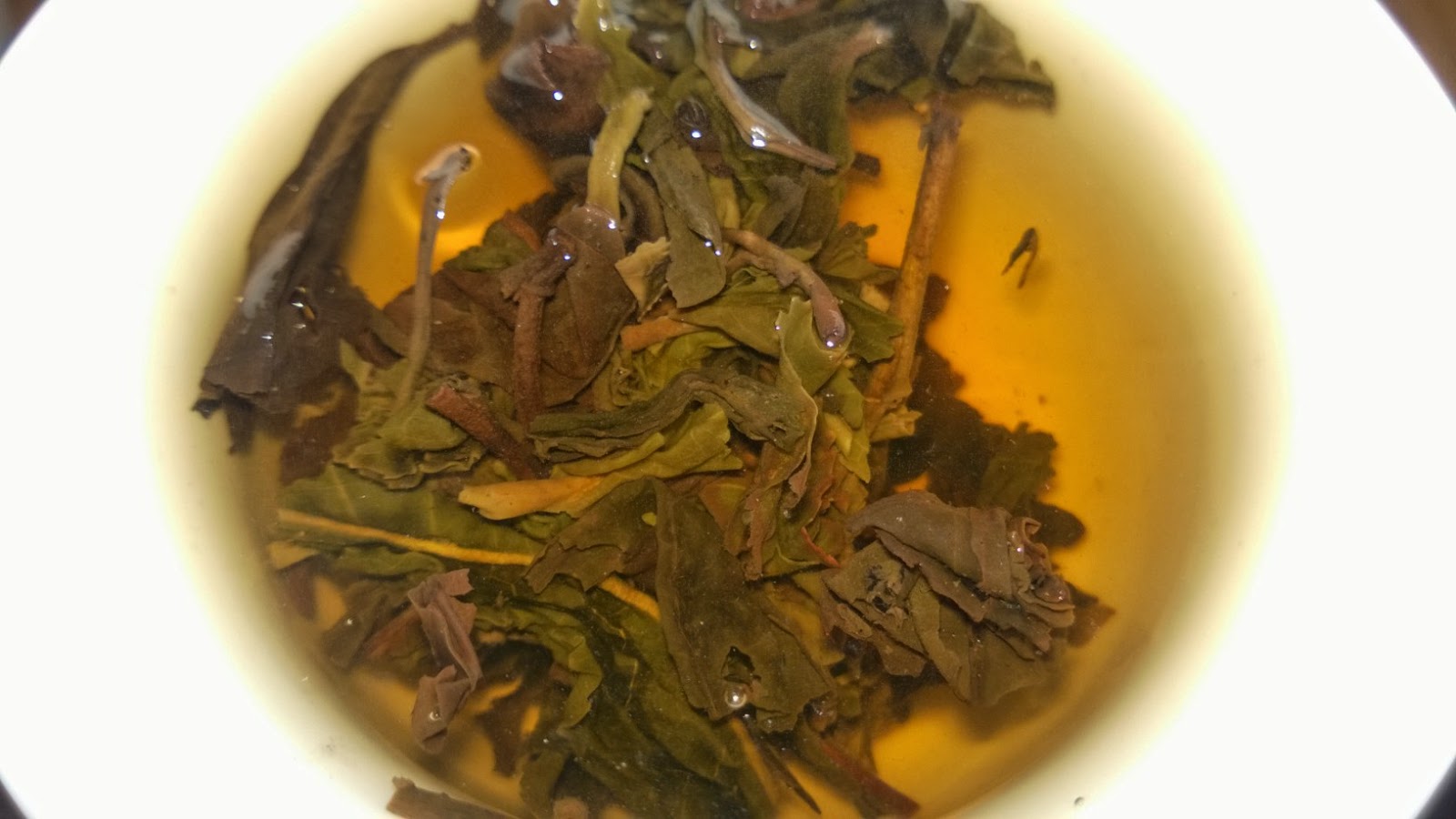


I was reminded of an herbal tea crossed with a very young sheng, in the early infusions I kept thinking I was drinking some herbal tea, but in the later ones it feels more like a puerh. The liquor was the darkest of the four samples, I was planning on doing at least two side by side comparisons, but I don’t have enough tea left over to do so. Otherwise a very nice sheng, I definitely want to find a cake or two of this. Maybe Crimson Lotus Tea will be nice enough to part with one (please!)?


Grade: 3 1 bud 3 leaves


Dry Leaves: The aroma was much weaker than the grade four. Otherwise the leaves are pretty similar to grade 4's, but there are a couple fuzzy (ish) silvers mixed in which I didn’t notice on the image on Crimson Lotus Tea’s blog.


Temperature: 175oF
Brewing Time: Thirty Seconds (+5)N+1
Aroma: Vanilla, Menthol/Listerine and Medicinal
Flavor: Menthol, Vanilla, Kuwei, Medicinal and Lavender.
Tasting Notes: The vanilla was a little weaker this time, the menthol became the star of the tea. Otherwise it is nearly identical (in taste) to grade four, but the liquor is lighter and something is missing from it. I don’t why, but this made me think of Vanilla Coke, even though it doesn’t taste that similar to it (I should note it’s been nearly a decade since I had vanilla coke).


I already mentioned that this tea is lacking something that the grade 4 had, but I am not sure what. I did get tea drunk off of this as well, but nowhere near as intense. If I had a chance to buy this cake, I could certainly see myself doing so, although I’d prefer the grade 4 if I had the opportunity.
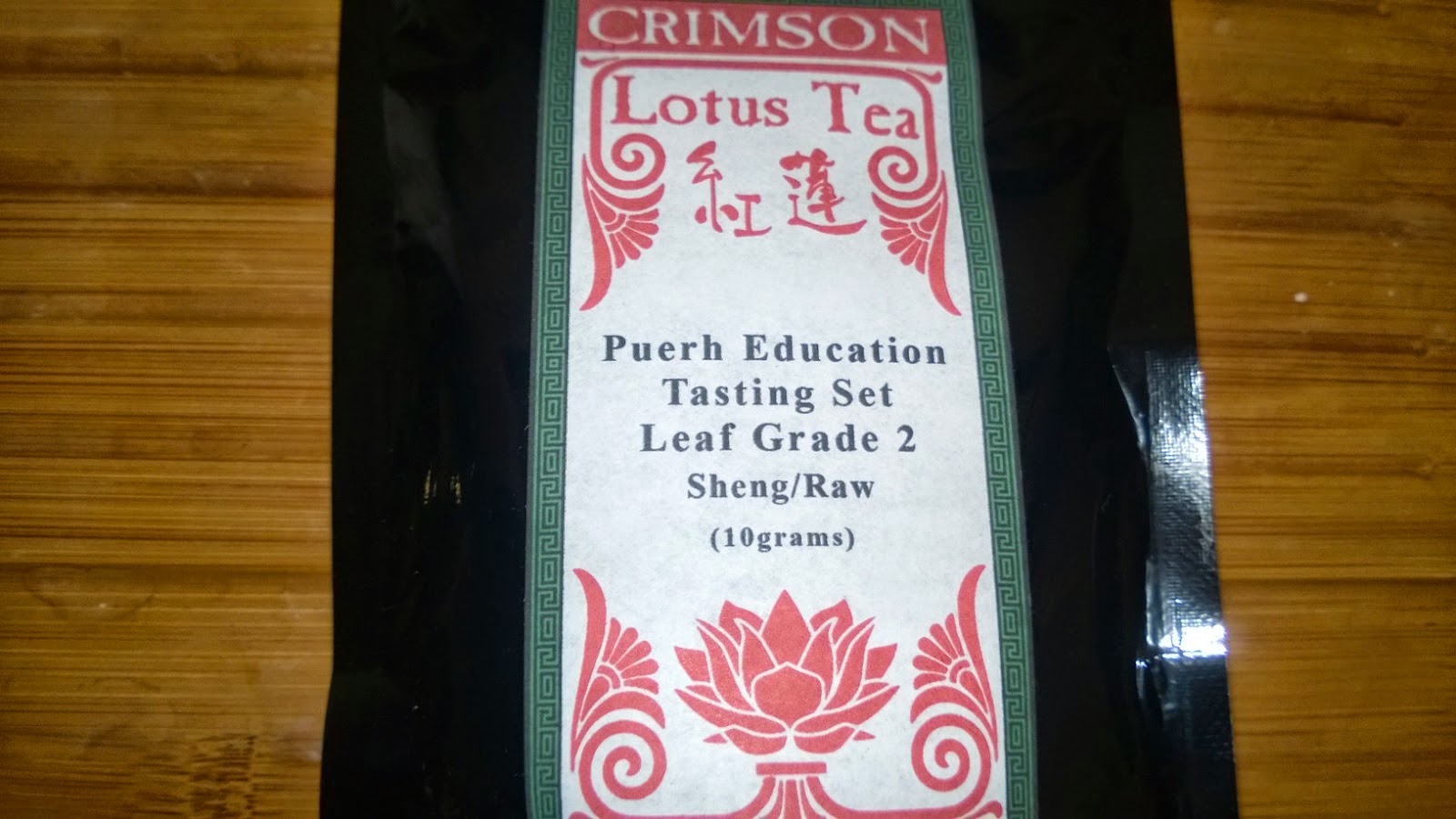
Grade: 1 bud 2 leaves


Dry Leaves: I didn’t have a big chunk of tea, my sample sort of looked like loose leaf puerh. There wasn’t much an aroma to the tea, but the leafs look fuzzier and more vibrant then the grade 3 and grade 4.


Temperature: 175oF
Brewing Time: Thirty Seconds (+5)N+1
Aroma: Vanilla and Mint
Flavor: Meaty, Mint and Bitter
Tasting Notes: This was rather disappointing. The weird Menthol/Listerine and Medicinal aroma was gone; it became a very distinctively mint. And there was a new meaty flavor that was nauseating. I got at least ten infusions out of the grade 4 and grade 3, but I only got to my third with this one before I gave up.


I don’t know what went wrong with this one, I brewed it the same way in the same gaiwan as the others, but it taste very different from the other samples. If I had a chance I wouldn’t pick this up again.

Grade: 1 bud 1 leaf


Dry Leaves: Pretty similar to Grade 4 and 3, less pungent though. 


Temperature: 175oF
Brewing Time: Thirty Seconds (+5)N+1
Aroma: Vanilla and Menthol
Flavor: Spearmint, Vanilla, Bitter and Floral
Tasting Notes: This was the grade I was most looking forward to, I originally thought it was going to be the best in some way, but it wasn’t. Don’t get me wrong it was rather nice, but it was too clean tasting. It felt a little soulless compared to the others, although I still prefer this to grade 2.


I prefer grade 4 to this, but it is slightly better than grade 3. While grade 3 & 4 feel like daily drinkers, I don’t think I could drink this that often. If given the chance I’d gladly buy a cake of this. Otherwise I think grade 4 was the best of the sampler, followed by this while grade 3 comes in a close third and grade 2 gets the dreaded participation trophy.

I am a little disappointed I feel in love with grade 4 and was fond of grade 1 & 3 and would love to buy a cake or two of them, but Crimson Lotus is only selling the sampler. Can’t help, but think Glen of a Crimson Lotus Tea is a bit of sadist. Now I don’t go around throwing libelous statements around, but this statement in the Sheng Puerh Education Set description leads me to think that he is a sadist:


I’d be glad to experiment with the uniqueness of each grade (with the exception of grade 2), just sell me the cakes! I suppose I’ll have to check out Crimson Lotus Tea’s 2011 CPTR Award Winning "Paka" 200g Mini Bing Cake once Crimson Lotus is open again. 

Teatulia Oolong Tea Bags

(Tea Provided for Review)
Origin: Bangladesh


More bagged tea?! I was rather impressed with the Teatulia White teabags I tried before, but I know oolong needs as much room as possible to expand, so I came in a little hesitant with this. Regardless I was excited to try it. Once again I decided to compare this tea in its teabag to it being brewed loose.


Dry Leaves: I had a hard time photographing the teabag, it seemed more reflective then the White teabag even though they both feel to be identical regardless, there was a slight orange aroma and the tea leaves are quite dark. 


Tea Bag:
Temperature: 190oF
Brewing Time: Two Minutes
Aroma: Toffee and Woodsy
Flavor: Candied Orange, Lemon, Cherry, Spice and Orchid
Tasting Notes: At first it felt like a run of the mill Indian oolong, until I could taste beyond the initial orange. It had a nice tart lemon flavor and something like cherries cooked in wine. I was surprised to taste Spice, more on the cinnamon side than anything else, and orchid. Regardless I rather enjoyed this.


I don’t think I ever had a bagged oolong that was not disgusting, but this was quite pleasant. The real question is how does it taste compared to being brewed sans teabag?


Loose:
Temperature: 190oF
Brewing Time: Two Minutes
Aroma: Toffee, Woodsy and Honey 
Flavor: Candied Orange, Lemon, Cherry, Spice and Orchid
Tasting Notes: There was a new aroma that I didn’t taste when I brewed this in its teabag form; I am not sure how it happened, but there was a honey scent. Perhaps I missed it last time, or there could be some variation within the tea leaves leading to the difference. Regardless it was rather interesting that this had a new aroma and was rather stronger than the last (even though it has a much lighter liquor). I suppose the teabag concentrates the tea leaves to a small area, while this allowed the leaves to expand to their fullest.


Honestly I preferred the teabag over brewing this loose which is really surprising I am not a fan of teabags or generally the quality of bagged tea, but Teatulia is causing me to rethink this. Regardless for $8.99 for sixteen teabags (at the time of writing this) this is worth trying.  


White2Tea New aMerykah 2 2014

(Tea provided for review)

So I finally decided to write up my thoughts on White2Teas’s 2014 New Amerykah 2. Of course I had this and a couple other samples since December that I’ve been leisurely sampling a little bit at a time.


Dry Leaves: I had a large sample about 14 grams; it’s a nice mix of browns and greens with plenty of fuzzy silvery leaves. It’s not that tightly compressed, I could easily break it apart without a pick. It doesn’t have much of a smell, but I could get something medicinal when I was breaking off a chunk.


First Steeping
Temperature: 185oF
Brewing Time: Ten Seconds
Aroma: Hay and Meat
Flavor: Hay and Mineral
Tasting Notes: I started out with a quick five second rinse, perhaps I should have had a longer rinse or even a second. I’ve heard of teas tasting or smelling like strange things, but I always imagined those people were exaggerated or did not have clean palate. But I can assure you I could distinguish meat in this! Other than that I was not getting the bitterness promised on the description.

I wonder if I should have used more tea, I only used four grams in my 85ml gaiwan, I thought about using more, but I had a feeling that this was going to be a tea that expands a lot (and it did). I was not disappointed with this so far, but I was hoping for more bitterness. Will this tea ever develop the kuwei that I was promised?


Second Steeping
Temperature: 185oF
Brewing Time: Fifteen Seconds
Aroma: Beef Jerky, Hay and Medicinal        
Flavor: Pleasant Bitterness, Hay and Mineral
Tasting Notes: Oh god yes. It developed a nice bitterness very fast; perhaps I should have rinsed it more? I am always a little apprehensive about rinsing puerh, more often than not I try the rinse even though I know I should skip the boring rising action and go straight to the climax, but I am always worried I am going to miss something out. Regardless it suddenly became bitter and astringent while staying incredibly smooth and creamy. I know many people avoid bitter or astringent teas, but I’ve been craving a nice bitter tea for a while; normally I can be assuage this craving with a Sencha, but I’ve only liked a handful of the Snechas I tried in 2014 which has lead me to try more Shengs.

The liquor is still a golden-peach color which is a little deceptive; this is a lot stronger than it looks.


Third Steeping
Temperature: 190oF
Brewing Time: Twenty Seconds
Aroma: Medicinal
Flavor: Pleasant Bitterness, Hay, Vegetal and Fruity
Tasting Notes: Bitterness is weakening, it still there for the next five or so infusions. There is a new vegetal flavor that is quite nice, with the hay notes it sort of reminds me of a yellow tea. Everything is a lot sharper than the last infusion although nothing is biting except the Fruity/Apricot taste. I was very impressed with this infusion (definitely my favorite of the three infusions here), but the longer you go with this tea the better it gets.

In later infusions I was getting sweet tobacco that transitioned into honey-floral. It becomes very rich and syrupy as you go on. Definitely a tea to enjoy slowly, I am not sure if I would want to do longer rinses or infusions after trying this three times. It certainly benefits from being brewed with higher temperatures (I think 190oF is a nice starting temperature). Although I rather enjoyed experiencing the transition to from a shy thin tea to an insanely thick boisterous tea; towards the end it was starting to feel like a high mountain oolong, it had a nice syrupy mouthfeel that coated the back of my throat. Regardless TwoDog is currently selling a 25g sample for $7 and a 357g cake for $69.50 and I definitely think it is worth checking out. I tend to prefer puerhs that are good now rather than waiting a couple years for it to develop more character, but I feel this is a perfectly drinkable tea today, although I am curious how it will taste in a couple years.


Obubu’s Limited Edition Okinawa Shincha 2014

Origin: Okinawa
Harvest: Spring


I am almost a year late on this, but we can pretend it is a Kuradashi Sencha (an enriched tea that is best a couple months after harvest), except that it is a Shincha and I have never heard of a Kuradahi Shincha. Regardless I’ve been having a lot of Taiwanese oolongs recently and have been craving a proper Japanese green tea. So I’ve decided on trying this Okinawan Shincha that I bought from Obubu.


Dry Leaves: Smells very fresh and grassy. Some of the leaves look machine harvested, but this was a relatively inexpensive tea so it isn’t that big of deal. Leaves are mostly blueish green although there is quite a bit of yellows and lighter greens.


First Steeping
Temperature: 160oF
Brewing Time: One Minute
Aroma: Grassy
Flavor: Grassy and Buttered Vegetables
Tasting Notes: It was very simple, but perfect. I was a little surprised at how murky the water became when I was brewing this in my houhin. Besides that this reminds me a little of a Kabushincha and a little bit of Gyokuro, although it is missing the sweetness of a kabushincha and the depth of a gyokuro. Regardless it was quite interesting despite its simplicity.

It had almost no astringency. I almost want to place this on the sweeter side of the bitter-sweet spectrum of Shinchas, but it lacks sweetness and bitterness which is something I have not encountered often with Japanese greens. It is a very neutral tea.


Second Steeping
Temperature: 165oF
Brewing Time: One and a half Minutes
Aroma: Wet Grass              
Flavor: Grassy, Vegetal and Citrus
Tasting Notes: Still a very neutral tea, although the citrus flavor is making it a little tart. It still is a very mild tea, I might have described this as plain, but it is very subtle and delicious. While I do tend to prefer teas with stronger or more complex flavors, this was quite nice. Definitely not the type to dazzle you, but the kind you can only appreciate with a clean palate and plenty of time.

This was my favorite of the three infusions. It feels like the quintessential Japanese tea, very reserved, but one can easily see the prettiness if one pays attention.


Third Steeping
Temperature: 170oF
Brewing Time: Two Minutes
Aroma: Wet Grass
Flavor: Grassy, Vegetal, Tangy Berry and Citrus
Tasting Notes: It’s starting to remind me a lot of a guricha which is a shame, it is starting to lose some of its charm. Not that it isn’t still enjoyable, but it is becoming a little generic. In later infusions it develops an almond flavor and becomes essentially guricha. Starting to be on the sweeter side.

Overall an interesting Shincha and for 50g at $11 (at the time of writing this) it is not a bad deal. Definitely worth checking out if you are a fan of Senchas, and it is a nice introduction to Japanese teas if you are worried about bitterness. I did find the packaging a little garish, but it was an amusing contrast to a very unassuming tea to have a very bright package. My major criticism of this is that it loses its uniqueness in later infusions. I’ve been drinking an ungodly amount of vibrant and loud teas this year; I have been craving the simpler more refined teas and the first two infusions was both simple and refined, but it started to lose both in later infusions when minor flavors started to appear. Regardless I am quite fond of this tea and it was an interesting experience to see a tea blossom from a meek beauty into something louder.