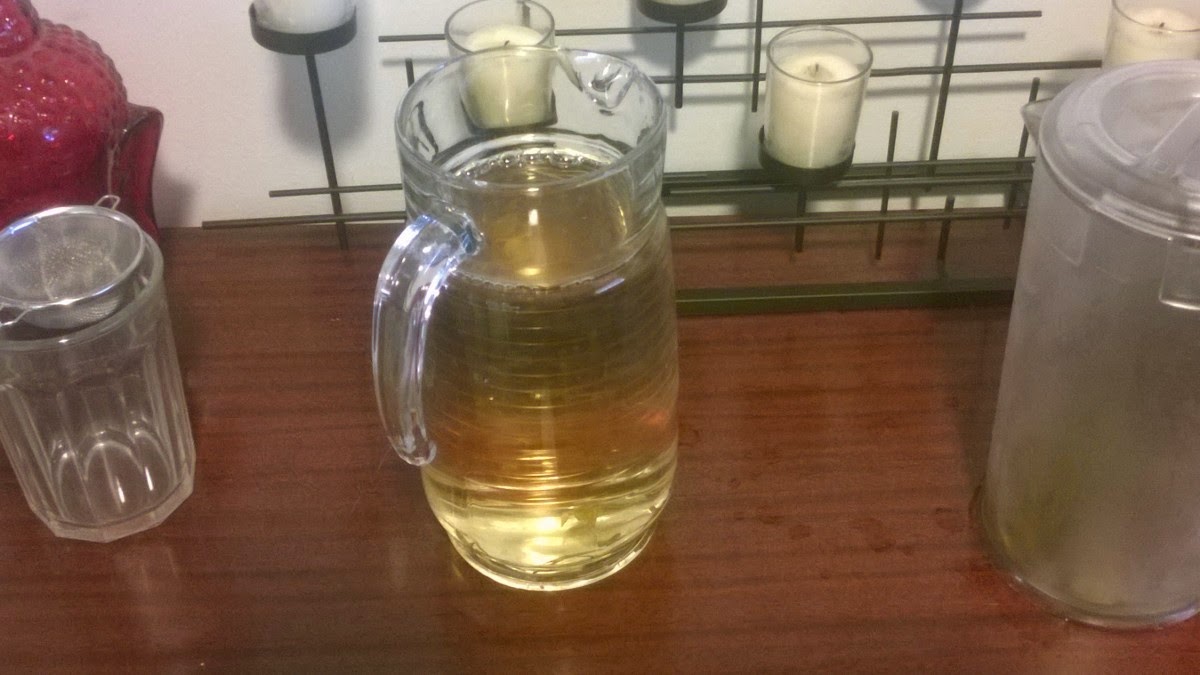
(Edit: I've been told the ideal starting time is forty-five seconds.)
I
decided to look at Beautiful Taiwan Tea’s Misty Mountain before I ran out! I
decided on having a mini gongfu session today, but first let’s talk a little
about this tea. It was grown at a whopping 1800 meters above sea level; while
not the highest grown tea at Beautiful Taiwan Tea it is certainly higher than
those philistine teas grown at or below sea level. For those who don’t know teas grown at higher elevations,
generally take longer to grow and are very different from tea grown at a lower elevation.
Misty Mountain is a tightly rolled tea whose
shape is somewhere between pearl and pellets, when unfurled become small leafs, generally two or three per stem.
Misty Mountain has a mild floral scent and a stronger damp earth smell, not surprising
for a tea named Misty Mountain
I
started with a quick ten second rinse using boiling water to open up the
leaves, although I probably should have done a twenty second rinse since the
leaves were about 40% unfurled. For my first infusion I brewed at 190°F for
thirty seconds (every subsequent infusions I add five degrees and fifteen
seconds). The liquor was very clear, and the aroma was a little weak, somewhat
floral. There were some very light sweet notes and a little fruity as well as being buttery. It had a
thin (for a high mountain oolong) mouthfeel, but still thicker than a normal
tea mouthfeel.
For
my second infusion I found it to be more enjoyable. It had a strong floral
aroma, something like fresh gardenia crossed with dried chrysanthemums. This time the liquor became a light
greenish-yellow and had a crisp floral taste that contrasts with a very general earthiness and a nice pear taste, although it is does not linger, but the liquor coats your throat nicely.
For
my third infusion it developed a nice wet stone aroma and the floral notes are still there. I’ve found the liquor to be very creamy and although the liquor
looks nearly identical to my previous infusions. It still has a pear taste and a little earthy, but there is a nice honeyed finish. The liquor is still getting thicker.
I
got eleven infusions out of this, and as I went on it became nuttier and becomes
thicker every time, it only starts to wane around the ninth infusion. The floral aroma doesn't become overwhelming like some
oolongs have a tendency to do, but it lost its earthiness around my fifth
infusion. I think I prefer not having a gongfu session with this tea, I feel
that it really benefits from longer
brewing times (starting around three minutes or so) although doing so loses
some of the nuances of this tea. If you are a fan of very crisp and pure teas, I’d
recommend this to you.


I had a little trouble with this tea, it has a very general Taiwanese High Mountain Oolong feel, but there was always something on the tip of my tongue that I could never identify. My
previous attempts at brewing this tea have led to sweeter more honeyed notes,
and considerably thicker then what I had today. Interestingly enough I feel
that this tea brews up well in unfiltered water. I’ve accidently used my very
hard tap water once while brewing this tea and found it to produce a very thick
mouthfeel.
In case you didn't notice, look how insolently I used a JianShui instead of a yixing. I
am going to look into my water filter situation, right now I am using a Zero
Water filter, but I’ve noticed my teas have had lighter than normal liquor.
(I
decided to change up the format of this blog a little, instead of brewing both
western style and having a gongfu session, I’ll do one and then revisit the tea
at a later date and do the other. This way I’ll be able to revisit the tea with
a fresh palate later on. I am also looking into buying less reflective teaware,
a careful reader of this blog could notice in my previous posts I have been posting
underexposed pictures because of how shiny most of my teaware is.)


The
dry leaves are a remarkably bright shade of green for a Long Jing, the leaves
are a little broken up, but I most note that the box that my What-Cha order was
shipped in was really banged up; even my postman apologized for the shape of
it. I haven’t encountered any of What-Cha’s teas being that broken up, so I am confident
saying this happened when it was in transit. There is a little yellow on some
of the leaves as well; the most notable part of this tea is the scent. It has a
really intense Chocolate-Mint aroma, not chocolate and mint, or chocolate
mints, but the chocolate-mint plant; this was quite interesting, I don’t think
I have ever encountered a Dragon Well with dry leaves that smell like mint.
Already I knew this was going to be a really interesting tea, although I should
have known it was going to be interesting when it said “What-Cha” on the label.


For
my first steeping I brewed at 176°F for two minutes. I was greeted with a nutty aroma, I was a
little disappointed that it didn’t have the chocolate-mint aroma from the dry
leaves, but I won’t hold that against this tea.
This tea had a very dominant nutty taste, think lightly roasted nuts,
but there also was a green bean undertone to it that was quite lovely. The liquor
was very light, although if I used a white cup rather than a clear glass cup it
might have been easier to see.
For
my next infusion I brewed at 185°F for three minutes. While it still had a
nutty aroma, this time I could also distinguish some vegetal notes to it, a
little bamboo and peas. The taste was similar to the last, but less roasted
nuts and a new wet wood taste that lingered. The liquor was still light, but I
think I enjoyed this infusion more than the last; it’s not often that I taste a
wood element in a Long Jing.
For
my third and final infusion I brewed at 190°F for four minutes. The aroma was
very weak at this point; I could only get the nutty scent this time. The
strongest flavor this time was peas, and then a very generic nutty taste.
This
was quite an interesting Long Jing, if What-Cha stocks the 2015 spring harvest,
I’d buy again, I am interested if the grower and roaster can duplicate the
chocolate-mint aroma the dry leaves had.
I don’t think What-Cha mentioned what Tea Estate this tea came from, but
I wonder what side of the West Lake it is situated, although in the title it
says it is wild growing which leads me to believe it may have been in one of
the mountains as it doesn’t taste like Dragon Wells grown in some of the more
polluted areas of Zhejiang and that it is wild growing makes me think it comes
from a more affluent tea growing region (of Zhejiang). Overall it was a very
good tea that I am looking forward to having again.
According to Chaidim’s website OrganicShin Chin No. 17 is a hybrid tea cultivar otherwise known as Ruan Zhi, I’ve had
Ruan Zhis in the past, but I never had one from Thailand before, in fact this
is my first tea grown in Thailand. Ok that is not exactly true, I’ve had Cha
yen (Thai Tea) before, but this is my first loose leaf tea from Thailand.
The dry leaves are large hand rolled
similar in size to jasmine pearls, but a lighter green with a little yellow in
some of the leaves. I didn’t have enough tea to do both a gongfu session and my
preferred western brewing, unfortunately. I’ll have to buy some more later on
and revisit it.
For my first session I brewed at 190°F
for three minutes after a quick ten second rinse at the same temperature. It
has a very similar mouthfeel to a Taiwanese Four Season, perhaps a little
thinner. It has a very floral aroma and taste; it also has minor honeysuckle
notes in it. As for taste, it has a very soft grassy taste; interestingly it is
a little milky although nowhere close to a Milk Oolong.
I brewed again at 200°F for four and
half minutes. The floral aroma became more distinctly orchid than anything
else, it had a slightly thicker mouthfeel than the last infusion. The taste was
still milky, but not grassy like the last infusion, although there was a new
nutty taste that was quite nice. I’ll have to buy a couple more teas from
Chaidim in the future, this is such an interesting tea that is very similar to
Taiwanese oolongs, but at a more modest price.
I rather like Chaidim’s Organic Shin
Chin No. 17 and I can imagine this being one my staple teas. It’s interesting
that Chaidim list under the feature tab on this tea that it was harvested
October 2013 and that is was grown between 600 and 800 meters above sea level
which completely blows my mind. While it isn’t as distinct as a Taiwanese High
Mountain Oolong, it is remarkably similar even when grown at such a comparably
low elevation.
I should have posted this earlier, but I have a lot of tea to sample. Most of it is from What-Cha, but here is a list of what I have to try and what I have already tried:
- Nepal Moonsoon Flush 2014 Pearl Oolong Tea ✔
- Zhejiang Purple Bamboo Shoot Zi Sun Cha Green Tea ✔
- Yunnan Graceful Purple Zi Juan Purple Varietal Green Tea ✔
- Zhejiang Wild Growing Dragon Well Long Jing Green Tea ✔
- Discover Russia - Premium Non-Black Tea ✔
- Discover Russia Green Tea
- Darjeeling First Flush 2014 Rohini Emerald Green Tea ✔
- And a small sample of Nepal First Flush Mao Feng that Alistair included with my order
I think I am most curious about trying the Russian teas since I never had teas from Russia before, but at the same time worried about. They are for the most part are described as having a Russian finish,
My
camera still is not working properly; although this time I have most of the
important images minus the used leaves.
Today
I was really in the mood for a smokey green tea and I felt like trying
What-Cha’s Yunnan Graceful Purple Zi Juan tea, although I mistakenly grabbed
the Zhejiang Purple Bamboo Shoot 'Zi Sun Cha' Green Tea package without
realizing it (and even when I brewed the tea I completely ignored the name on
the bag). So I was a little confused during my tasting when I thought I was
brewing a purple tea. I didn’t realize my mistake until I brewed it a second
time and looked at the bag.
I tried to do a gongfu session with
this tea, but the liquor was very light so I decided to skip that and go
straight into western brewing. I know the liquor color is not always indicative
of the brewed tea, but I decided to be vain and judge the tea by its
appearance.
For my first infusion I used water at
176°F for three minutes. I couldn’t really discern an aroma while the
aroma of the dry leaves was very intense (spinach, mushroom and spinach). The
liquor was very light I tasted a very dry hay taste and slight nutty
undertones.
For my second infusion I brewed at
180°F for four minutes. This time I was getting a very slight orchid scent. The
liquor was still light, but not as delicate as the last infusion. This time it
was nuttier than anything else, although it was vaguely vegetal.
For my third and final infusion I
brewed at 190°F for five minutes. It still had the orchid scent from the last
infusion, but it also had cherry hints. The taste was pretty much identical to the last.
(I was confused here, because I had
not realized that this was not a smokey tea. Ok in my mind I knew it wasn’t a
purple tea, but I have yet to have a mislabeled tea at What-cha.)
Round 2
I decided to start again (still did
not look at the name on the bag) and steep the tea even longer than before.
With my new leaves I brewed at 185°F for four minutes. This time I was getting
an orchid and vegetal scent. As for the taste, it wasn’t drastically different
from my first infusion, it still was nutty, and the hay taste was the star.
For my next infusion I brewed at 195°F
for five and half minutes. This time it was very different. The liquor was pale
like all earlier tries, but the taste was amazing. This time it had a sweet
edge as well as being nutty. The sweetness tasted raw like freshly picked
sugarcane.
(At this point I finally discovered
that this was not a smokey purple tea)
I am rather fond of this tea, even
though before my realization it confused me while it is a lot lighter than my
everyday type of green tea. I found it enjoyable. This Zi Sun Cha feels like a
white tea drinker’s introduction to greens, as well as the reverse. Although if
I blindly tasted this I might think it was an oolong because of the floral
notes to it. This is too light of tea for me to recommend gongfu brewing this;
it becomes interesting the longer it is steeped. I also found it interesting
that the leaves feel like they can be continuously reused even though I had
relatively long steep times, it never felt watery or thin. I feel that I can
serve this to any guest without them complaining about the bitterness (all my
guests are unenlightened plebeians who mistake astringency with
bitterness).
.png)